WeChat Official Account
WeChat Official Account
 APP Download

Scan the QR code Download the STEM STAR APP

On the way to school, the elevated pillars block the view, forming an unnoticeable blind spot. Most people would pass by it. But in the classroom of the STEM STARideaLab launch program, the first question the children face is:Can we design a device that actively alerts people around us when making a turn?
Thus, a seemingly ordinary everyday phenomenon gradually transformed into a design sketch, a set of hardware modules, a graphical program, and repeated testing and modifications. Ultimately, it became a smart helmet equipped with a turn signal reminder function.
This is exactly the kind of science and technology learning that STEM STARideaLab hopes children will experience:Instead of waiting for others to provide answers, we should identify problems in the real world and try to create solutions ourselves.
STEM STAR was founded in 2016 and started its journey on the campus of Shanghai Jiao Tong University. Over the past ten years, it has grown into a globally renowned technology education brand, with more than 140 learning centers established in over 70 cities both domestically and internationally. As an innovative laboratory dedicated to youth invention and creation under the brand, ideaLab adheres to the educational philosophy of "teaching for understanding, learning for innovation" and is committed to cultivating 21st century global citizens with scientific literacy.
How does the Sailing Plan help children learn to create?
Creating a work and completing a creation are two different things. Science and technology innovation is complex, but the first step for children should not be complicated.
The first two works teach children how to create;The last item has no unified answer.

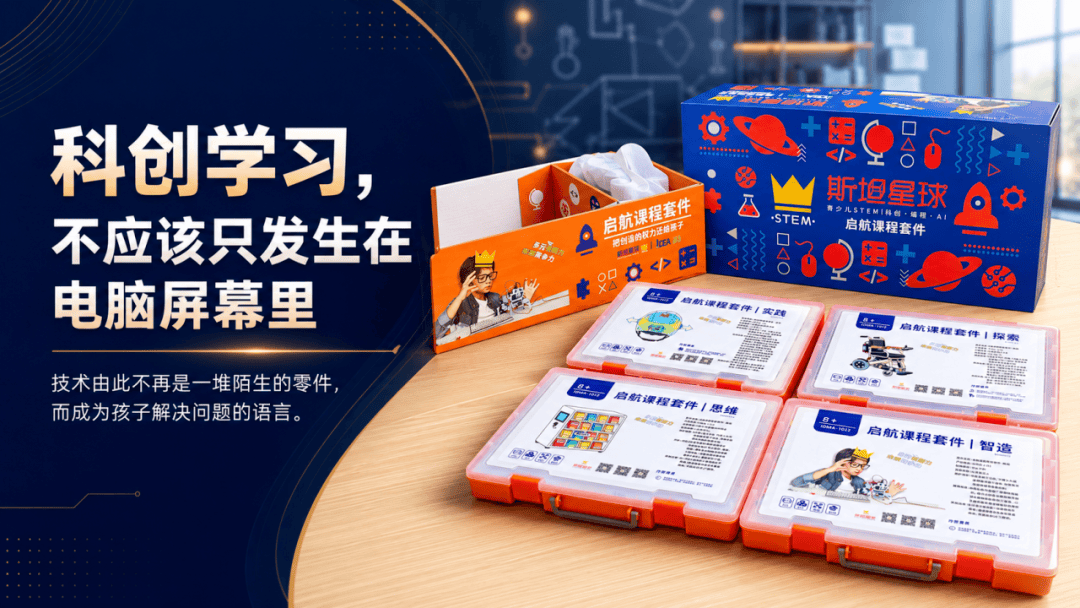
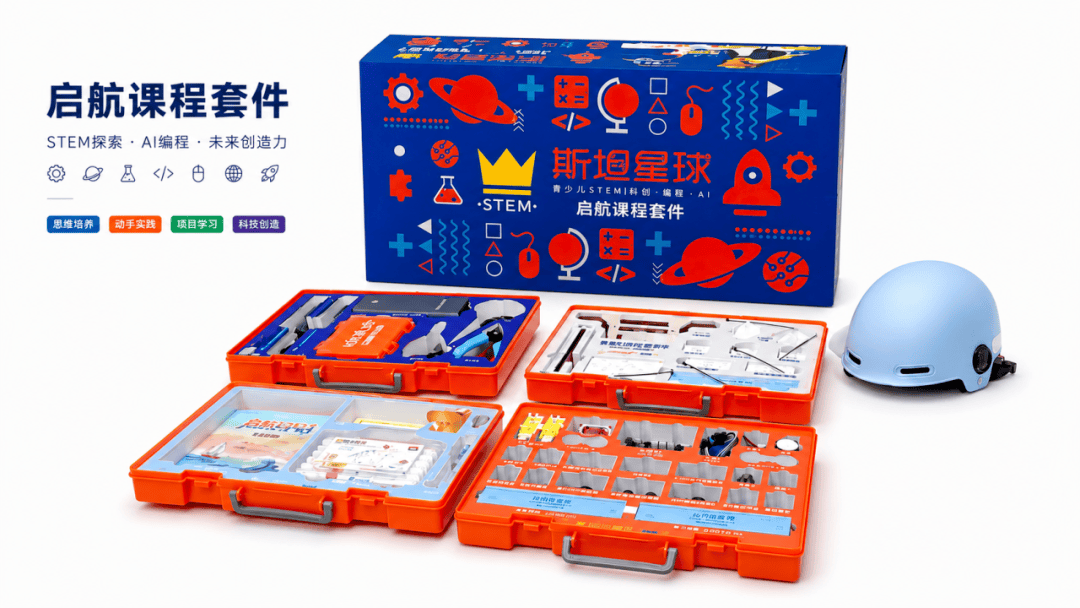
In the Sailing Plan, the purpose of children using technology is not to memorize more professional terms. Perception modules such as light, distance, and temperature are the "eyes and ears" through which the work perceives the environment; lighting, screen, and sound modules are the ways through which the work expresses information; motors and servos bring an originally static idea to life. The various hardware sensors and laboratory tools in the accompanying curriculum kit provide space for children to realize their different ideas.
But the tool itself is not the protagonist.
What truly matters is that children begin to learn how to select the appropriate tools based on their own questions. It's not about "the teacher asked me to use which sensor today", but rather:To realize my idea, I need to determine what the artwork sees, hears, and reacts to? Technology is no longer a pile of unfamiliar parts, but a language for children to solve problems.
Why can the Launch Plan achieve a genuine creation?
A truly original work that belongs to a child can hardly be born in just one or two trial classes. It requires time to observe and also time to make mistakes and learn from them.
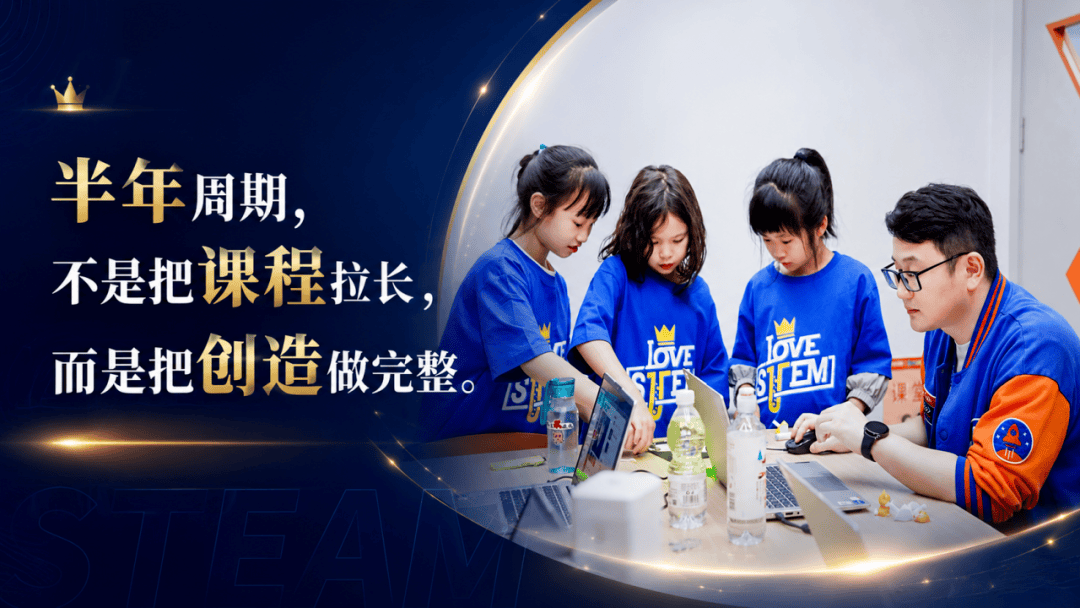
The "Sailing Plan" spans approximately 6 months, consisting of 15 regular weekly classes and 3 days of intensive training during holidays, totaling 73 class hours. Children will experience the following steps in sequence: outdoor exploration and hardware introduction → problem statement and definition → solution and appearance design → hardware selection and function implementation → assembly, programming, and function debugging → display board production and project defense.
Over the past six months, the focus has not merely been on enabling children to complete their projects. The more significant value lies in allowing them to undergo an indispensable process in a real-world project: the first plan may not be entirely reasonable; the first wiring may not produce any response; the first program may not run smoothly; and the first attempt at expressing oneself may fail to articulate one's thoughts clearly.
But children will learn to observe phenomena, find reasons, modify plans, and then retest.In scientific and technological innovation learning, failure is not the end of a project, but the basis for the next design.
At the end of the course, the child will complete an original and personalized scientific and technological creation. However, the creation is only the most intuitive part of growth. There are also these less intuitive parts of thinking: What problem did I discover? Why did I choose this problem? What solution did I design? What technology did the creation use? What difficulties did I encounter during the testing process? How did I revise and improve it.
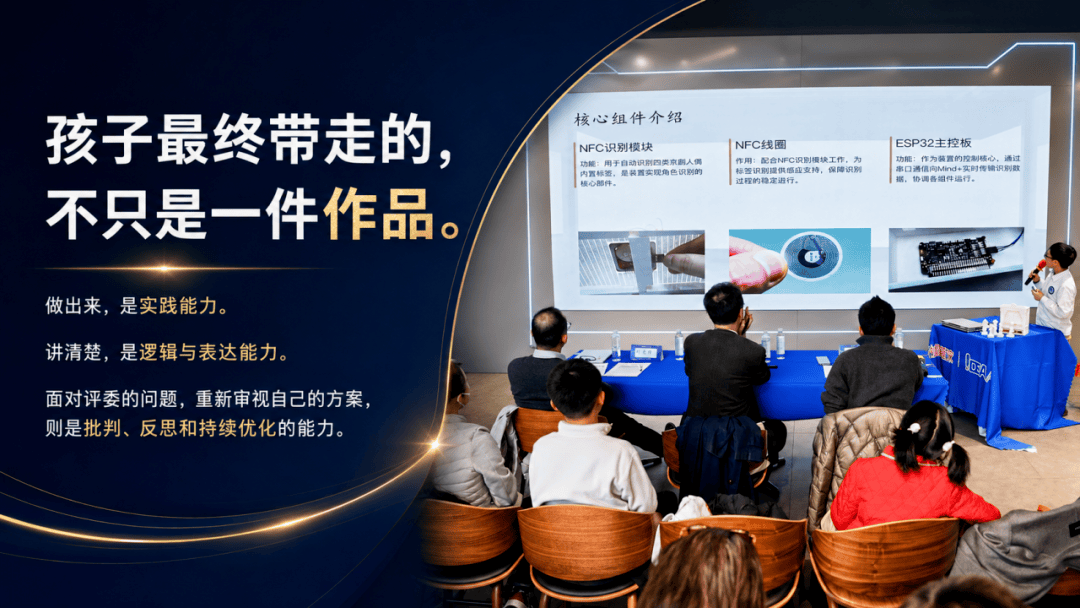
The final stage of the course specifically includes a project roadshow session, allowing children to organize the logic of their projects and enhance their expression and presentation skills.At the same time, the curriculum observes children's growth and outputs literacy reports centered around various scientific and technological literacy, and provides opportunities for original works to participate in domestic and international science and technology competitions.
To execute a project is a matter of practical ability. To articulate one's ideas clearly requires logical and expressive skills. When confronted with questions from judges, the ability to re-examine one's own plan demonstrates critical thinking, reflection, and the capacity for continuous improvement.
To enable young children to complete genuine science and technology projects, they need a clear learning path, outdoor activities that help them open their minds, project promotion methods suitable for young children's understanding, and technical support that matches different ideas.
Therefore, STEM STARideaLab is systematically designed around the same goal: a curriculum path from topic-defining training to free creation; a problem-finding link in real outdoor scenarios; a card game to help young children initiate projects; a complete process from production, debugging to presentation and defense; and supporting hardware kits, literacy evaluation, and competition outlets.
Our research and development capabilities are ultimately not solely reflected in the number of parts in our teaching aids or the number of pages in our courses. They are more evident in enabling every child to start from a small question mark and progress towards their own first original invention.
About STEM STAR
STEM STAR, founded in 2016, is a globally renowned technology education brand. Drawing on international advanced STEM education concepts and practices, we have carefully crafted an integrated STEM & AI curriculum system. Tailored to the interests and strengths of young people aged 3-18, we have planned four core learning paths: artificial intelligence, informatics Olympiad, robot programming, and scientific and technological innovation, providing diverse development directions for children's technological growth.
Specifically, it covers a wide range of content, including Python AI programming, information and communication technology (ICT) C++, VEX robotics, scientific and technological innovation, scientific experiments, building blocks, mechanical engineering, thinking training, outdoor research and study, etc. Leveraging high-quality software and hardware platforms and cutting-edge technologies from both domestic and international sources, it helps children better understand and apply these concepts.
As an excellent brand focusing on science and technology education, STEM STAR has established over 140 learning centers in more than 70 cities both domestically and internationally. In recent years, its brand influence has extended globally, with active student groups in countries and regions such as the United States, the United Kingdom, and Australia.
Since its inception, STEM STAR has always adhered to the belief of "benefiting children and being responsible for parents", adhered to the educational philosophy of "teaching for understanding and learning for innovation", and is committed to becoming a benchmark for global children's STEM education.
 TikTok
 WeChat Official Account
 Headline